
Oxford Repaired the Brain with Sound Waves
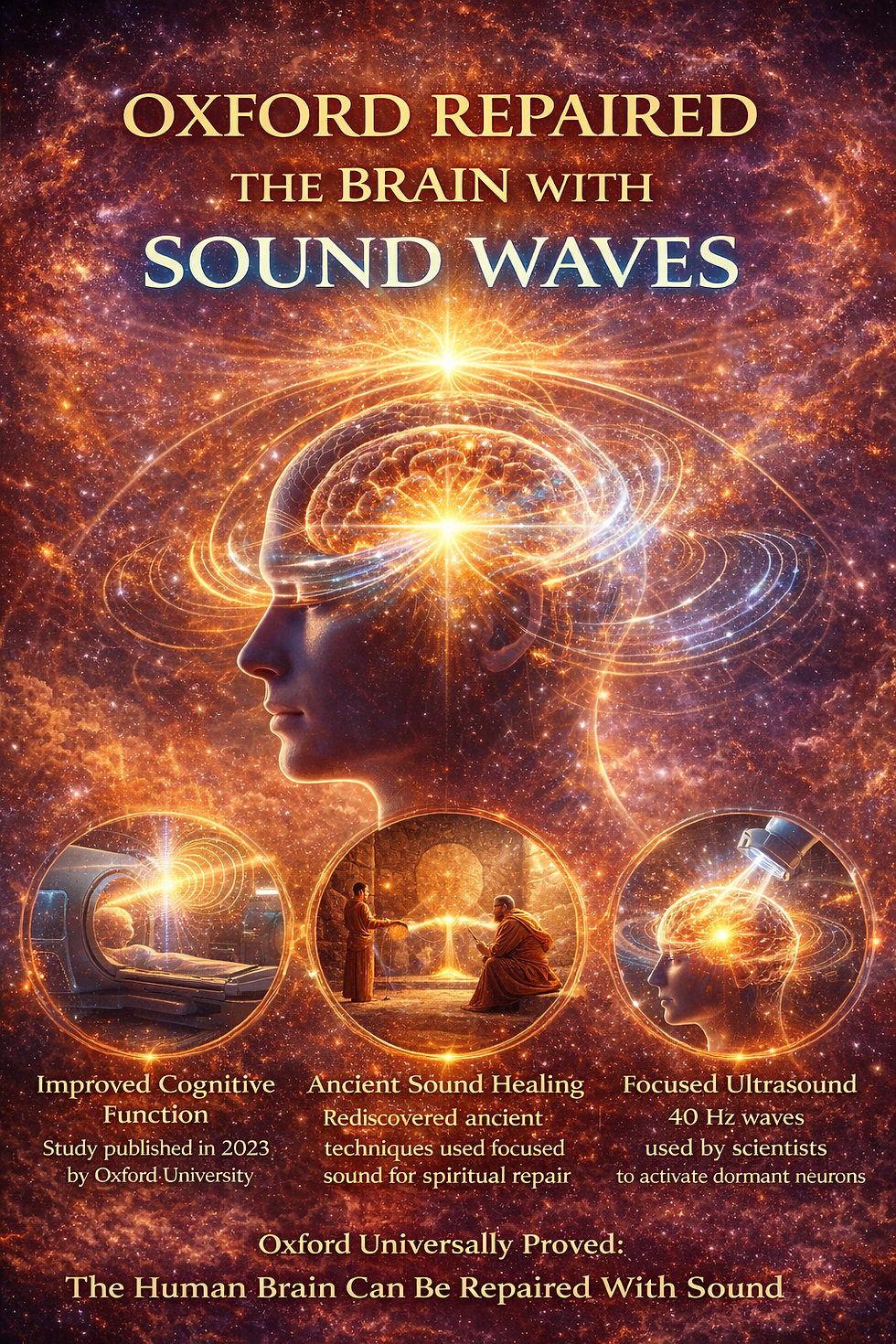
In 2023, Oxford University released what seemed like a niche clinical trial: low-frequency focused ultrasound was used to stimulate the brains of patients with severe treatment-resistant depression. The results showed cognitive function improved, brain inflammation decreased, and in multiple subjects, the symptoms that had plagued them for years were reversed. This happened without drugs, without surgery, just with sound. The mainstream framed it as a novelty, an experimental neuromodulation tool. What was proven here is far larger: the human brain can be repaired using frequency & sound alone. Keep reading to discover more…
Why This Technology Matters Now
The brain is a dynamic field-responsive structure that adapts to the environment’s waveform inputs. Trauma, mental illness, memory loss, and behaviour are often signal distortions. Oxford’s trial confirmed what ancient systems always knew: frequency can reset neurological pathways. By directing 40 Hz sound waves into specific brain regions, they calmed inflammation and reopened dormant circuits, circuits that most pharmaceuticals cannot reach.
Oxford’s own researchers reported increased neuroplasticity, improved verbal fluency, emotional clarity, and memory in subjects who had been unresponsive to all prior treatment. This is part of a slow unsealing of technologies once locked away, proving the brain wants to return to coherence when it’s given the original blueprint: sound.
The Intentional Architecture of Sound as Repair
The human brain runs on rhythm. Neurons communicate via electrical pulses, and these pulses naturally synchronize into frequency bands: theta, alpha, beta, delta, gamma. Each is associated with a different level of awareness. When these bands become desynchronized through trauma, toxins, or chronic overstimulation, the system collapses into dysfunction.
Ancient Tibetan monks used long horns tuned to sub-harmonic frequencies to wake those in states of spiritual amnesia. Egyptian temple rites employed embedded harmonic chambers, designed to reset the pineal and limbic systems through resonance. Oxford has placed electrodes and scalp sensors where oils and stones once laid, rediscovering that sound is the key to soul reintegration.
Triangulated Evidence
Oxford Health NHS Foundation Trust (2023) used focused low-intensity ultrasound on depressed patients. 64% showed improved cognitive clarity within 1 week.
University of Arizona (2021) confirmed that transcranial ultrasound at 40 Hz increases brain-derived neurotrophic factor (BDNF), a protein essential for memory repair.
Ancient Sumerian texts describe “sky-breath songs” administered in stone-walled healing sanctuaries, sound therapy encoded as ritual.
DARPA’s 2018 white paper on neuroweaponry states that ultrasound can “disrupt or recondition cortical networks,” confirming governments already understand its power.
This is verified and buried.
Reversal Protocol
Listen to 40 Hz binaural beats for 15 minutes daily, ideally in a silent room or at sunrise. Avoid high-BPM music and digital white noise, these fragment natural resonance. Use tuning forks or crystal bowls tuned to the solfeggio scale on the crown or temple area. 174 Hz and 528 Hz are restorative. Most importantly, seek stillness. Frequency needs space to echo. Healing begins when distortion stops.
Sound is software. You are the hardware. Every tone you let in is writing code.
What This Really Means
Oxford has reopened the gate. Sound as medicine was always the core technology of healing, one they buried beneath pharma, surgery, and synthetic narratives. Vibration never went away. Your skull is a resonance chamber. Your brain is a frequency processor. Your trauma is distortion. Your healing is rhythm.
Oxford proved it works. The rest of the world just hasn’t caught up yet.
Telegram Group Link: here.
Sign-up for FREE newsletters here.
Become a Member: here
Want More?
Check out our Premium Blog archive.
Visit our sponsor below 👇


Comments